Bachkovo Monastery: A Self-Guided Visitor's Guide to Bulgaria's Second Great Cloister
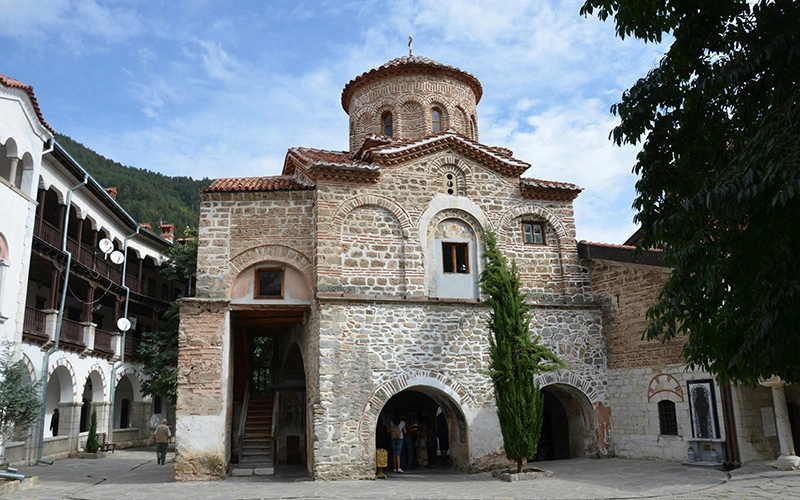
Bachkovo Monastery is the one major Bulgarian religious site where visiting independently is clearly better than joining a group - and where most day-trippers walk straight past the single most important building on the property. Founded in 1083, it is the second largest monastery in the country after Rila, and the oldest parts of it predate almost everything else standing in Bulgaria. Entry to the courtyard and main church is free. There is no ticket queue, no timed entry, and no need for a guide to walk you through the gate.
What you do need is a short list of what to look for. This guide provides it.
Why Bachkovo Monastery Suits Independent Travellers
Coach tours treat this as a 45-minute stop, usually bolted onto a Plovdiv itinerary. That is enough for the courtyard and a photograph of the frescoes. It is not enough for the ossuary, the refectory, or the exterior panoramic fresco - which together are the actual reason art historians come here.
Three practical advantages of going alone:
- Long opening hours. The grounds are open from 07:00 to 20:00 in summer and 07:00 to 19:00 in winter. You can arrive at opening or stay for evening vespers. No tour schedule allows either.
- Free entry to the core site. The courtyard and main church cost nothing. You pay only for the museum and refectory, which are inexpensive.
- You can stay overnight. The monastery runs a guesthouse. Very few visitors know this, and it transforms the experience.
The History in Three Minutes
The monastery was founded in 1083 by Gregory Bakuriani, a Byzantine military commander of Georgian origin, together with his brother Abasios. For roughly its first century it functioned as a Georgian monastic community, which is why the architecture and early decoration blend Byzantine, Georgian and later Bulgarian elements. That mix is unusual anywhere in the Balkans.
Two later details matter:
- Patriarch Euthymius, the last medieval Bulgarian patriarch, was exiled here after the Ottoman conquest at the end of the 14th century and is buried on the site.
- The complex was destroyed and rebuilt. Most of what you see above ground dates from the late 16th and 17th centuries onward. The main church of the Dormition of the Virgin was completed in 1604.
What to See at Bachkovo Monastery
The ossuary - the part everyone misses
The two-storey ossuary is the only surviving building from the original 11th-century foundation. It sits roughly 400 m from the main complex, along a path outside the walls, and it is not visible from the courtyard.
Inside are medieval frescoes of a quality you will not see anywhere else in Bulgaria, including scenes of the Baptism of Christ, the Raising of Lazarus and the Communion of the Apostles. It functions as a museum rather than an active chapel.
Critical practical point: it is not always open on demand. You need to ask inside the monastery about access. Turning up and expecting an open door is the most common disappointment at this site. Ask at the shop or the museum desk as soon as you arrive, not as you are leaving.
The main church and the miraculous icon
The Church of the Dormition of the Virgin holds a silver-clad icon of the Virgin Eleusa, traditionally dated to the 14th century and associated with the monastery's Georgian origins. It is a working pilgrimage object, not a museum piece. On feast days the queue to venerate it stretches across the courtyard.
The refectory
The old dining hall contains a long marble table dated 1601 and a fully painted interior. The frescoes here are among the finest 17th-century wall paintings in the country. There is a modest entry fee.
The exterior panoramic fresco
On the outer wall of the refectory is a large 19th-century fresco by Aleksi Atanasov showing the monastery, the surrounding mountains and an Easter procession. It is one of the few surviving painted panoramas of its kind, and it is free to look at. Most visitors walk past it because it faces away from the main entrance.
The Church of St Nicholas
Decorated by Zahari Zograf, the leading painter of the Bulgarian National Revival. His Last Judgment scene is worth the few minutes it takes to find.
Getting to Bachkovo Monastery
From Plovdiv - the easy option
The monastery sits in Bachkovo village, about 10 km south of Asenovgrad and roughly 30 km from Plovdiv. Driving takes 35 to 45 minutes along the Chepelarska river valley.
By bus, take a service from Plovdiv's Rodopi station toward Smolyan or Chepelare and ask for the Bachkovo stop. Services run several times daily. The monastery is a short uphill walk from the road.
From Sofia
About 190 km and two hours by car via the Trakia motorway to Plovdiv, then south. If you are coming from Sofia, do not treat this as a standalone trip - pair it with Plovdiv or Asen's Fortress, or the driving outweighs the visit.
Parking
There is a paid car park directly outside the walls, charged as a flat fee. It fills quickly on weekends and Orthodox holidays. Arrive before 10:00 in high season.
Pros and Cons of Visiting Independently
Advantages
- Cost. Free entry to the courtyard and main church, with only small charges for the museum and refectory. A full independent visit costs a fraction of any organised tour.
- Time. You can attend a service, sit in the courtyard, and walk the ossuary path without watching a clock.
- Combination freedom. Asen's Fortress is 10 minutes away by car and is skipped by most tours.
Drawbacks
- Limited interpretation. Signage is sparse and mostly in Bulgarian. Without preparation, the layered history is invisible.
- Ossuary access is unpredictable. A guide with a relationship at the monastery can sometimes arrange what an individual cannot.
- Cash only in places. Card acceptance at the museum and refectory desks is inconsistent.
Practical Tips From Experience
- Dress modestly. Shoulders and knees covered, for men and women alike. This is enforced more strictly here than at Rila. Carry a light layer in summer.
- Bring cash. Bulgaria adopted the euro on 1 January 2026 and it has been the sole legal tender since 1 February 2026. Small euro notes and coins are the safest option for the museum, refectory and parking.
- Ask about the ossuary first. Do this on arrival. If access needs arranging, you want the time to wait.
- Go on a weekday morning. Weekends bring Bulgarian pilgrims and Plovdiv day-trippers in volume. Early weekday mornings are close to empty.
- Consider evening vespers. The service around 18:00 is open to visitors and is the most atmospheric hour of the day. Stand quietly at the back and do not photograph.
- No flash photography inside churches, and some interiors prohibit photography entirely. Check before lifting a camera.
- Skip the roadside stalls for lunch. The village restaurants along the river serve local trout from the Chepelarska, which is the regional speciality and considerably better than what is sold at the gate.
- Staying overnight is possible at the monastery guesthouse, booked directly. Expect monastic rules: modest dress, no alcohol, and shared rooms for married couples only. If those terms suit you, waking up inside the walls is the single best thing you can do here.
Building a Full Day Around the Visit
- 08:30 - Arrive at Bachkovo Monastery. Ask about ossuary access immediately.
- 09:00 - Main church, then the refectory and its exterior panoramic fresco.
- 10:00 - Walk to the ossuary.
- 11:00 - Drive 10 minutes north to Asen's Fortress, a 13th-century clifftop church and fortification with sweeping Rhodope views.
- 13:00 - Trout lunch in Bachkovo or Asenovgrad.
- 15:00 - Continue to Plovdiv old town, 40 minutes away, for the afternoon.
Final Thoughts
Bachkovo Monastery rewards preparation more than it rewards company. Free entry, generous opening hours and a compact site make it ideal for independent travel, but the two things that make the visit exceptional - the 11th-century ossuary and the painted refectory - are exactly the two that a rushed group stop leaves out. Arrive early, ask about the ossuary at the door, dress for a working monastery, and give Bachkovo Monastery three unhurried hours rather than forty-five minutes.